

Salvia, this is my terrific perennial which blooms throughout the growing season from summer to late fall.
Perennial or Annual
Salvia comes in annual as well as perennial varieties. I personally love perennials, since there is only one purchase required, one planting to shovel, and with so little effort the flower gratefully returns year after year. With over 900 varieties to choose from, surely there will be one for you!
Hardiness Zone
Zones 5-10
Find out what gardening zone you live in to see how this plant will do in your area. Here is one of my all time favorite gardening websites The Old Farmer’s Almanac. It’s an incredible resource! On this website, you can find your gardening zone if you live in Canada or the USA. If you live in another country, please search “gardening zone map”.
It’s crucial to find your gardening zone, so you know which plants will survive & thrive in your climate.
Color
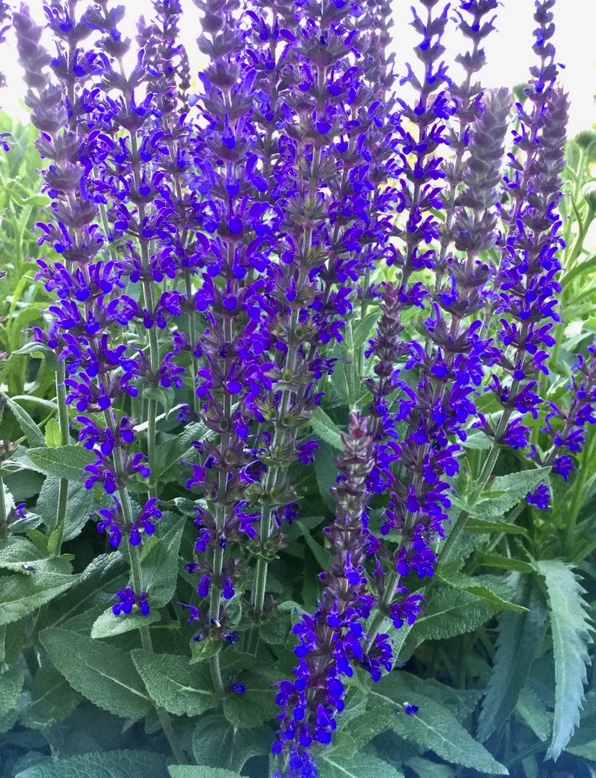
- Typically, Salvia blossoms are blueish-purple.
- Other varieties of Salvia are available and come in whites, pinks, reds, and yellows.
In gardening, the color blue is often sought after in a plant. Blue is not as prolific a colour as pinks, whites, and yellows are in the gardening world. This makes Salvia a wonderful addition to put next to whites and yellows for a punch of colour.
How it Blooms
In the photo below, some Salvia stems are blooming on the lower portion of the stem and not quite as colourful on the top ends of the stem. This is because Salvia delicate little blossoms open starting from the bottom of the step moving upward.
The arrows indicate the direction of the bloom. The upper portions haven’t opened yet, but each stem will bloom fully to the top!

Shape
This plant consists of a cluster of spiky stems. Each stem is covered with a multitude of tiny flowers. The shape is linear and would contrast well planted next to rounder shaped plants such as daisies.
Maintenance
Salvia is a low maintenance plant. As long as the flower has sunshine, it tolerates pretty much anything else.
- Deadheading
Periodically the plant needs to be deadheaded to encourage further stem growth and blooming. When a stem of Salvia finishes fully blooming, the whole stem turns brown and should be cut off. I’ve found that cutting old stems off with a pair of scissors a lot more accurate than with bulky garden pruners 🙂 maybe that’s just me!
- End of Growing Season
After first frost, Salvia can be cut down to a few inches above the soil. After a few years, Salvia can easily be divided.
Principal Points
- low-to-no maintenance
- blooms all summer long
- beautiful blue-purple color
- has long, column-like stems
- survives the toughest winters
- perennial, thus grows back each year exactly where you planted it
- part of the mint family, however Salvia stays in one location and doesn’t spread
 Siiri's Blog